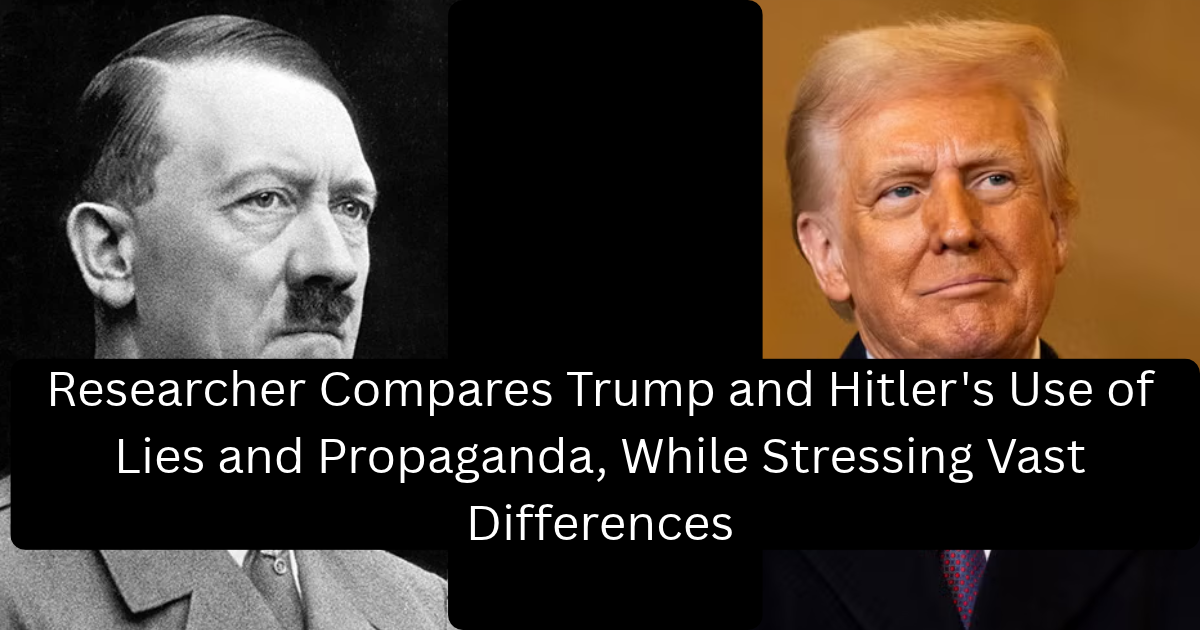
A new analysis finds parallels in rhetoric, scapegoating and attacks on institutions, but says the two cases differ enormously in scale and context
By Fazal Khaliq
A new research paper argues that Donald Trump and Adolf Hitler share recurring patterns of authoritarian political behavior, particularly the use of falsehoods as a political tool, while stressing that the comparison does not make Trump “another Hitler.”
The paper, “A Comparative Analysis of Donald Trump and Adolf Hitler: Authoritarian Leadership in Democratic and Totalitarian Contexts,” examines the two men across several areas: leadership style, nationalist rhetoric, propaganda, scapegoating and conspiracy theories, treatment of democratic institutions, military force and relations with the media.
Its authors say the aim is not to equate the two figures but to understand how authoritarian leadership can appear in very different historical and institutional settings.
The “big lie” and the fact-checkers
The paper’s central focus is deception. It notes that Hitler wrote in Mein Kampf about the psychology of the masses and developed what became known as the “big lie” technique: the idea that a sufficiently audacious falsehood is more believable than a small one. It points to the Nazi “stab-in-the-back” myth, the false claim that Germany lost World War I because of internal traitors, as a key example of propaganda that told people what they wanted to believe.
On Trump, the paper relies heavily on fact-checks by CNN’s Daniel Dale of the president’s 2026 State of the Union address and of his statements about the Iran war. According to those fact-checks, as cited in the paper, Trump overstated the size of investment secured since his return to office, misstated gas prices, mischaracterized inflation under his predecessor, and wrongly said tariffs are paid by foreign countries. The paper also cites analysis from the Federal Reserve Bank of New York and the Congressional Budget Office indicating that most of the tariff burden falls on U.S. firms and consumers.
The author argues that in both cases falsehoods did more than misinform. They helped create alternative realities in which the leader’s account overrides objective fact, cast opponents and democratic processes as illegitimate, and presented the leader as uniquely farsighted.
Other parallels the paper draws
- Personalist leadership: Both men built followings around personal loyalty rather than institutions, the paper says, citing Stanford political scientist Bruce Cain’s description of Trump as “playing the classical authoritarian game.”
- Nationalism and humiliation: Both framed their countries as humiliated and promised restoration. Trump has openly called himself a nationalist.
- Scapegoating: The paper notes that Trump’s 2023 remark about immigrants “poisoning the blood of our country” drew comparisons to language in Mein Kampf.
- Institutions: Both were hostile to constraints on executive power and withdrew from international bodies. Hitler left the League of Nations in 1933; Trump withdrew the United States from the World Health Organization and the Paris climate accord.
- Media: Both sought to delegitimize independent press and to speak to followers directly, Hitler through staged mass rallies and Trump through social media.
The analysis draws on Henk de Berg’s 2024 book Trump and Hitler: A Comparative Study in Lying, which examines both men as political performers and explores their populist self-staging and rhetorical strategies.
The differences
The paper is explicit about the limits of its comparison. Hitler’s regime produced the Holocaust and a world war that killed tens of millions of people; nothing in Trump’s career approaches that scale, it says. Trump operates within a constitutional democracy with courts, a free press and elections, whereas Hitler rose in a defeated, economically shattered Germany. The paper also notes that historians describe Hitler as largely disengaged from daily governance, while Trump has been more directly involved in some policy areas.
A contested comparison
The comparison remains disputed among scholars. A survey of the debate in Central European History found that historians of Germany have played a prominent role in explaining Trump, but cautioned that Nazi analogies may distort rather than deepen understanding of present-day politics. Critics of such comparisons argue that they can trivialize the Holocaust and obscure what is distinctive about American politics. Supporters respond that analogy, used with attention to differences, can help identify warning signs. As the historian Charles Maier argued, comparison works responsibly only when it isolates what is different as well as what is similar.
The paper’s authors acknowledge that tension, concluding that understanding these patterns is essential to assessing risks to democratic institutions, but that American democracy does not face the same fate as Weimar Germany.
This article summarizes a research paper. Claims about Trump’s statements are drawn from fact-checks cited in that paper and have been attributed to their original sources rather than independently verified here. The White House has not been quoted; readers should consult the cited sources and the administration’s own statements for its position.