Regional powers test a homegrown approach to de-escalation as Houthi attacks continue, oil stays high and Washington keeps the option of new strikes open
By Fazal Khaliq
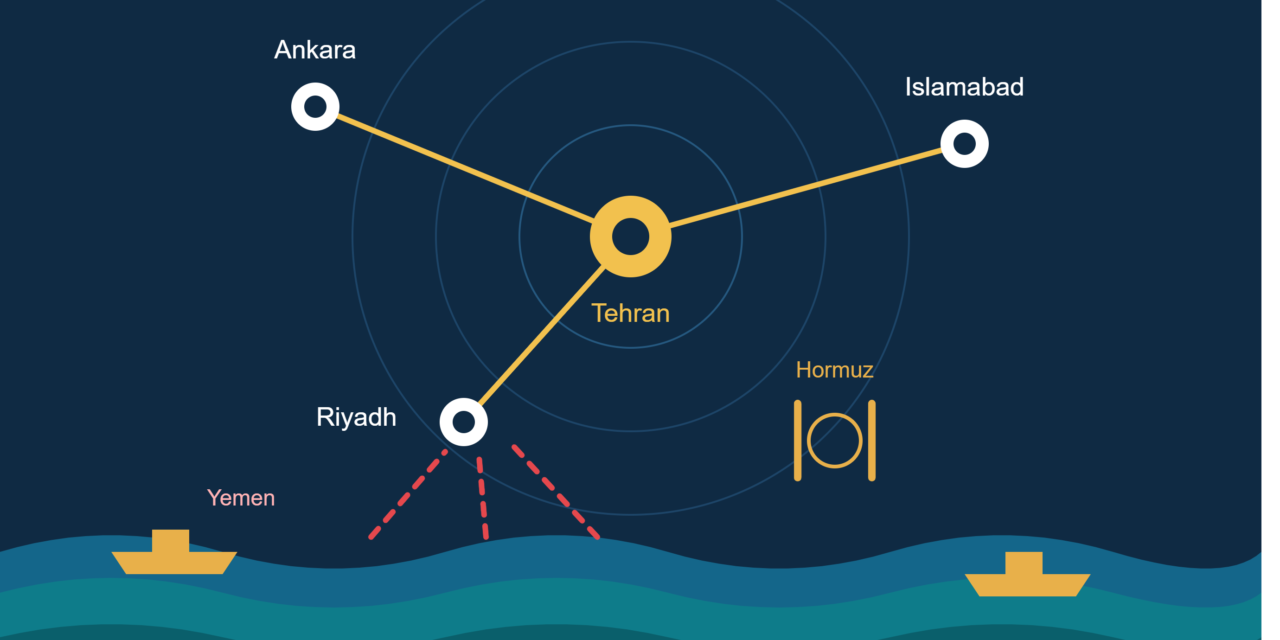
TEHRAN — Senior officials from Saudi Arabia, Turkey and Pakistan met Iranian leaders in Tehran on Monday and agreed to keep talking about regional “peace and security,” in the first high-level contact between Iran and the three states since the war spread to Saudi Arabia and Yemen.
The talks brought together Saudi Defence Minister Prince Khalid bin Salman, Pakistan’s army chief and Chief of Defence Forces, Field Marshal Asim Munir, and Turkish intelligence chief Ibrahim Kalin. Saudi Arabia, Turkey and Pakistan are the three signatories of the Mecca mutual defence pact signed in August. Mohsen Rezaei hosted the meeting, according to reports.
There was no breakthrough. As the delegations met, the Saudi-led coalition in Yemen said it had intercepted another barrage of missiles and drones fired by the Houthis at the kingdom.
Pakistan at the centre
Munir has become the most visible intermediary. Iranian media described Monday’s trip as his sixth visit to Tehran since the ceasefire between Iran and the United States took effect in April. During an earlier visit, Pakistani government sources told Anadolu Agency that he urged Iran to use its influence to stop Houthi attacks on Saudi Arabia, citing Pakistan’s commitment to defend the kingdom under the Mecca pact, and discussed ways to restart stalled US–Iran talks.
Pakistan’s leverage has limits. Indian media reported that Munir asked Iran to hand over its enriched uranium and that Tehran refused to do so completely. Iran’s security chief was quoted saying none of the country’s enriched material would leave Iran.
Oil and the Red Sea
Energy explains much of the urgency. With the Strait of Hormuz effectively closed during the war, Saudi Arabia has leaned on its East–West pipeline to ship crude to Yanbu on the Red Sea. The pipeline was shut for about two weeks in September after drone attacks, and the Houthis claimed new attacks on its pumping stations this week, which Saudi Arabia had not confirmed. Brent crude has recently traded above $115 a barrel.
China has taken notice. On Tuesday, foreign ministry spokesperson Guo Jiakun said Beijing would soon send a special envoy to countries in the region to promote dialogue and prevent the situation from worsening, and warned the conflict could spill into the Horn of Africa and the Red Sea. Last week, China and Djibouti agreed that easing Middle East tensions is key to security in both areas. Russia has also offered help: President Vladimir Putin told Iranian President Masoud Pezeshkian this month that Moscow would do “everything in our power” to end the war, though Russia is not an official mediator.
Washington keeps its options open
President Donald Trump said at the weekend it was “getting to be decision time” on whether to make a deal or resume attacks. He has suggested strikes could follow the 3 November midterm elections and has sent more forces, including a third carrier group, toward the Gulf. The International Atomic Energy Agency told the UN Security Council this week it cannot verify whether Iran diverted nuclear material, including 440 kilograms of highly enriched uranium.
US public opinion is also shifting. A Gallup poll in February found, for the first time since 2001, that more Americans sympathised with Palestinians (41 per cent) than with Israelis (36 per cent). The poll measures sympathy, not support for the Iran war.
What to watch
Supporters of regional mediation say Monday’s meeting shows Gulf and Muslim-majority states preferring negotiation to a wider war. Sceptics note that Houthi attacks continue, Iran has not conceded on its nuclear material, and Washington argues pressure, not talks, brought Tehran to the table.
Three tests will show whether the effort works: whether Houthi attacks on Saudi Arabia stop, whether Iran agrees to a verifiable arrangement for its nuclear material, and whether Washington chooses a deal over renewed strikes.
Reporting draws on Reuters, Anadolu Agency, IranWire, Associated Press, The Japan Times, Euronews, Oilprice.com and other outlets listed in the accompanying research paper. A report that Saudi Arabia offered the Houthis $1 billion for a ceasefire comes from a single Israeli outlet and is unconfirmed.